The thread: the zero line
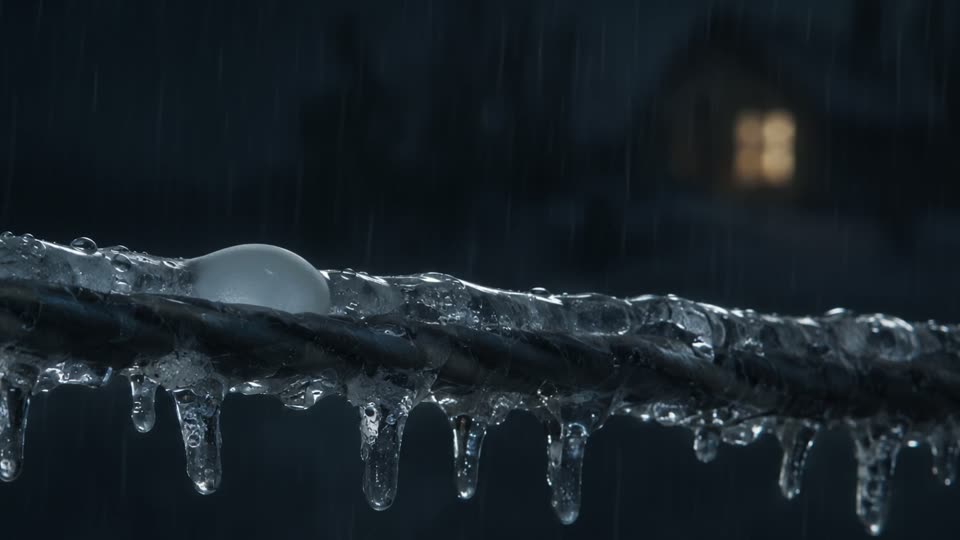
Freezing rain forms when a layer of warm, humid air rides over a layer of below-zero air near the ground: snow melts into rain, then the drops "freeze on contact". [1] From 1979 to 2016, the St. Lawrence and Outaouais valleys got the most freezing rain in Quebec, "reaching 40 to 50 hours per year". [2]
The federal climate service: "more winter precipitation falls as rain", which "can lead to localized flooding and freezing-rain events". [3]
The film’s caution: Environment Canada says ice storms "are not frequent during El Nino winters", and the 1998 storm was "partially caused" by El Niño. So the film says "set the stage", never "caused". [4][3] The 1999, 2010, 2018 and 2023 winters in the film were not El Niño winters: they show what the danger looks like, not that El Niño causes it.
1. The triangle of darkness, Montérégie
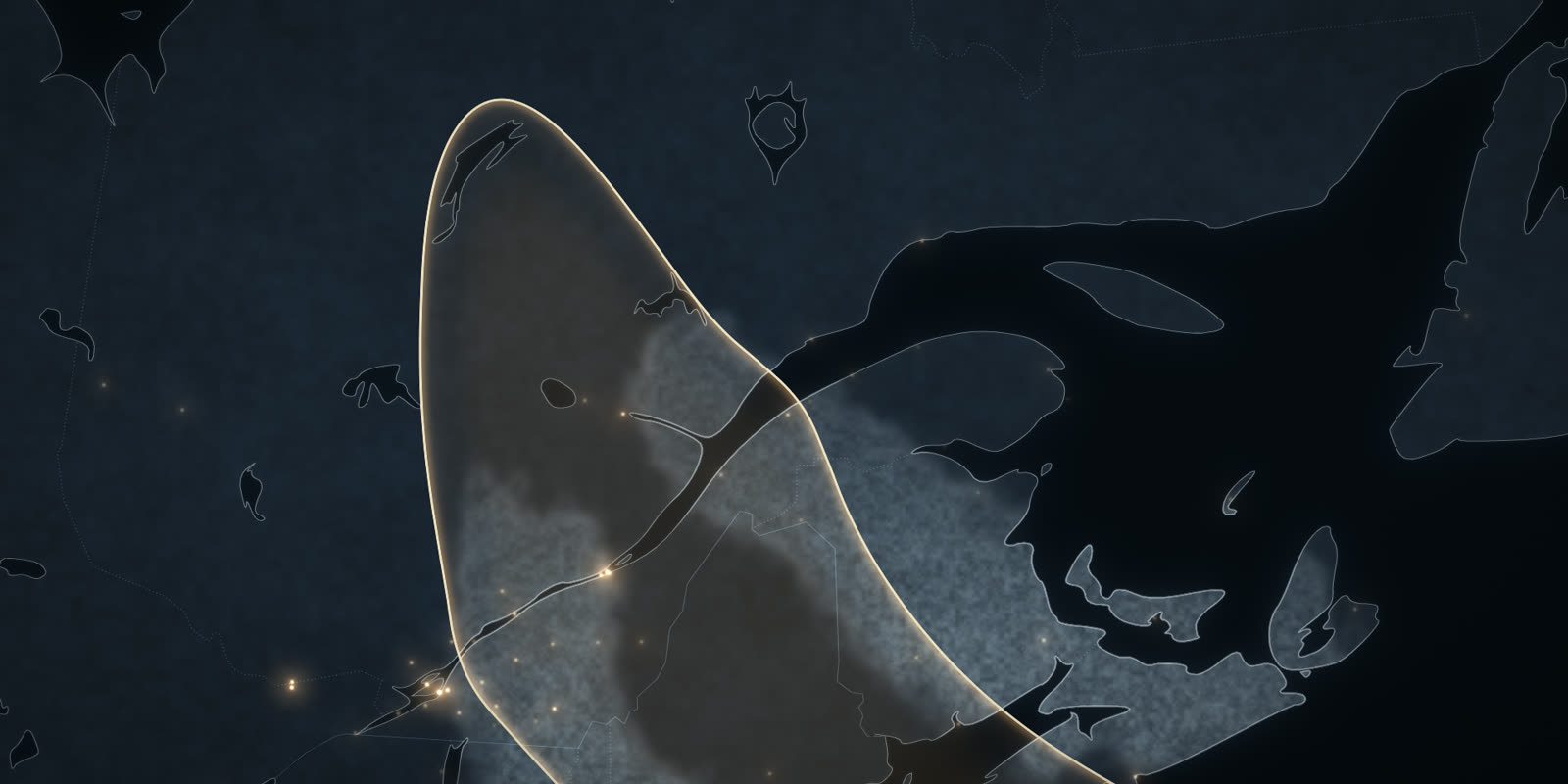
- "A total of over 100 mm of freezing rain fell in the area between the towns of Saint-Hyacinthe, Granby and Saint-Jean-sur-Richelieu." [1] "Up until 1998, transmission lines could resist a weight equivalent to about 45 mm of ice." [5]
- At the peak, on 10 January 1998, 1,393,000 Hydro-Québec customers were without power; the last one was reconnected on 6 February. [6]
- Thirty deaths in Quebec were attributed to the crisis. [7] More than 15,000 military personnel deployed, "the largest domestic troop deployment in Canadian history". [8]
- The danger came back, smaller: the glaze storm of 5 April 2023 affected more than 1.3 million customers. [9][10]
2. The Chaudière, at Beauceville
- The Chaudière is known for its floods, documented since the 1740s. [11]
- Ice jams form when the ice cover is broken up by rising flow after rain or a fast snowmelt. [12]
- On 21 December 1957, a winter thaw formed an ice jam at Beauceville and caused a major flood. [11][13]
- From 11 to 15 January 2018, 37 municipalities were hit by floods caused by a thaw, rain and ice jams. [14]
3. The Lower St. Lawrence shore
- On 6 December 2010, the water rose on average a little more than 2 m above the highest tide line at Rimouski, Sainte-Luce and Sainte-Flavie; the shore retreated up to 15 m in one storm. [15]
- That day there was no shore ice to slow the waves. [16] Sixty-five homes were later demolished; nobody was hurt. [17]
- In winter 2023-2024, a strong El Niño winter, "the ice coverage over the Gulf of St. Lawrence was the lowest on record". [18][3]
5. Haute-Gaspésie and the cliffs of Québec City
- Nearly 75 people have died in avalanches in Quebec since 1825. In Haute-Gaspésie, about 50 avalanches a year cover one or two lanes of Routes 132 and 198. [20]
- The surprise: from 1825 to 2007, most victims died at home, mainly in Québec City and Lévis, under short slopes, during or just after heavy snowfall. [21]
- Avalanche Québec publishes a bulletin every day from 1 December to 30 April. [22]
6. The cold that comes back
Be ready: the official advice
The film ends on the official advice, quoted as written and linked: the Get Prepared emergency kit [25], Hydro-Québec’s outage preparation and carbon monoxide pages [26][27], power outages on Québec.ca [28], and WeatherCAN alerts [29]. On the roads, from December to March, 48% of crashes from 2016 to 2020 happened on snowy, icy or slushy surfaces. [30]
How these facts were checked
Every source was read in its own text, web page or PDF, on the night of 21 November 2026. The file’s 214 quotes were checked automatically against the source text, then an independent check reread the film script before release. The film’s scenes are reconstructions, and the 2026-2027 season pictures are a simulation, marked as such on screen.
Sources
- 1"Extraordinary weather event" (A perfect storm), Hydro-Québec (undated). www.hydroquebec.com/ice-storm-1998/a-perfect-storm.html
- 2"Freezing rain - Observed changes", Ouranos (undated page; data from McCray et al. 2019). ouranos.ca/en/node/1920
- 3"What the developing exceptional El Niño means for Canada in 2026-27", ClimateData.ca (Canadian Centre for Climate Services, ECCC), Hayley Dosser and contributors, 21 Aug 2026. climatedata.ca/news/what-the-developing-exceptional-el-nino-means-for-…
- 4Environment Canada (MSC) brochure "El Nino: Canadian Perspective", archived 2006. bac-lac.wayback.archive-it.org/web/20060208000346/http://www.msc.ec.gc…
- 5"After 1998: A more robust grid", Hydro-Québec (undated). www.hydroquebec.com/ice-storm-1998/after-the-storm.html
- 6"The January Ice Storm" (timeline of January 1998), Hydro-Québec "Icy January" site (undated). www.hydroquebec.com/ice-storm-1998/
- 7"Quand le verglas fait trembler le Québec", Bibliothèque et Archives nationales du Québec, 28 Dec 2022. www.banq.qc.ca/explorer/articles/la-crise-du-verglas-25-ans/
- 8"1998 Ice Storm", Veterans Affairs Canada (undated). www.veterans.gc.ca/en/remembrance/military-history/service-canada/1998…
- 9"Verglas d'avril 2023 : Hydro-Québec à l'œuvre pour accroître la résilience du réseau", Hydro-Québec news release, 15 May 2023. nouvelles.hydroquebec.com/nouvelles/communiques/tout-quebec/verglas-da…
- 10"Canada's top 10 weather stories of 2023", Environment and Climate Change Canada. www.canada.ca/en/environment-climate-change/services/top-ten-weather-s…
- 11"Inondations sur la rivière Chaudière" (document de vulgarisation), COBARIC (Conseil de bassin de la rivière Chaudière), final version dated 20 Jan 2023 in its file name. cobaric.qc.ca/wp-content/uploads/2023/01/Vulgarisation_inondations-riv…
- 12"Risque d'inondations par embâcles de glaces et estimation des débits hivernaux dans un contexte de changements climatiques", Ouranos project page (B. Morse and B. Turcotte, 2016 to 2018 per COBARIC23). www.ouranos.ca/fr/projets-publications/risque-inondations-embacles-gla…
- 13"La tristement célèbre inondation de 1957", Patrimoine Beauceville (undated). www.patrimoine-beauceville.ca/la-tristement-celebre-inondation-de-1957
- 14"Sinistres marquants", Ville de Québec, Sécurité civile (undated). www.ville.quebec.qc.ca/citoyens/securite_civile/sinistres-marquants/in…
- 15Quintin, C., Bernatchez, P., Jolivet, Y. 2013. "Impacts de la tempête du 6 décembre 2010 sur les côtes du Bas-Saint-Laurent et de la baie des Chaleurs". LDGIZC and Chaire de recherche en géoscience côtière, UQAR. "Rapport remis au ministère de la Sécurité publique du Québec, Février 2013". ldgizc.uqar.ca/Web/docs/default-source/default-document-library/quinti…
- 16"Les grandes marées et la submersion côtière en 5 questions", Radio-Canada, 6 Dec 2025, updated 8 Dec 2025. ici.radio-canada.ca/article/info/2209475/submersion-erosion-cotiere-te…
- 17"Il y a dix ans, les grandes marées frappaient l'Est-du-Québec de plein fouet", Radio-Canada, 6 Dec 2020. ici.radio-canada.ca/article/info/1754883/grandes-marees-decembre-2010-…
- 18"Seasonal Summary Eastern Canada Winter 2023-2024", ECCC Canadian Ice Service. www.canada.ca/en/environment-climate-change/services/ice-forecasts-obs…
- 19"25 years on, mayor of Kangiqsualujjuaq, Que., reflects on tragic legacy of avalanche that struck school", CBC News North, 1 Jan 2024 (translated from Radio-Canada reporting). www.cbc.ca/news/canada/north/avalanche-kangiqsualujjuaq-quebec-nunavik…
- 20"Un brin d'histoire : Les incidents d'avalanche au Québec", Avalanche Québec (undated; covers winter 2018 to 2019). avalanchequebec.ca/incidents-davalanche-au-quebec/
- 21Hétu, B., Brown, K., Germain, D., "L'inventaire des avalanches mortelles au Québec depuis 1825 et ses enseignements", in Locat et al. (2008), Proceedings of the 4th Canadian Conference on Geohazards, Presses de l'Université Laval. cgs.ca/docs/geohazards/GeoHazards4/geohazard/alea/Hetu.pdf
- 22Avalanche Québec home page. avalanchequebec.ca/
- 23"Blast of extreme cold hits Quebec, prompting closures and postponements", Radio-Canada International, 3 Feb 2023. ici.radio-canada.ca/rci/en/news/1953386/blast-of-extreme-cold-hits-que…
- 24"What is the Polar Vortex?", NOAA National Weather Service, safety pages (undated). www.weather.gov/safety/cold-polar-vortex
- 25"Emergency kits", Get Prepared, Government of Canada (Public Safety Canada). www.canada.ca/en/services/policing/emergencies/preparedness/get-prepar…
- 26"Preparing for a power outage", Hydro-Québec. www.hydroquebec.com/safety/preparing-power-outage.html
- 27"What to do in case of Carbon monoxide poisoning during a power outage", Hydro-Québec. www.hydroquebec.com/safety/emergencies/carbon-monoxide-poisoning-outag…
- 28"Power outages", Gouvernement du Québec (Québec.ca). www.quebec.ca/en/public-safety-emergencies/emergency-situations-disast…
- 29"WeatherCAN", ECCC. www.canada.ca/en/environment-climate-change/services/weather-general-t…
- 30"Ralentissez et gardez vos distances. Adaptez votre conduite à l'hiver.", SAAQ press release, Québec, 13 Dec 2021. saaq.gouv.qc.ca/salle-presse/communique/ralentissez-et-gardez-vos-dist…
Research supported by Claude. Every fact was checked at the source before publication.
How we work: Our method · Corrections